Standing in the snack aisle, you want to spot sweeteners fast. The names for added sugar on food labels go well beyond “sugar”: think syrups, dextrose, maltose and more, so scan the ingredients list.
This guide is part of the wider topic of healthy snacks, where everyday choices are weighed on facts rather than packaging.
| Item | Value |
|---|---|
| Added sugar suggested by health professionals | Less than 10% of daily calories |
| Processed foods estimated to contain a sweetener | 75% |
| Worked label example in the guide | 10 g added sugar and 2 g natural sugar in one portion |
| FDA label rule compliance date, manufacturers with $10 million or more in annual food sales | July 26, 2018 |
| FDA label rule compliance date, manufacturers with less than $10 million in annual food sales | July 26, 2019 |
The figures come from a Utah State University Extension guide and the FDA final rule in the Federal Register. They can change, so check the source before you rely on them.
What counts as added sugar?
The Utah State University guide defines added sugar as “syrups and other caloric sweeteners used as a sweetener in other food products”, as set out in its added sugars overview.
That definition covers only sugars put in while a product is made. Sugars that occur naturally in fruit and milk are left out, according to the same guide.
The guide adds that health professionals recommend that less than 10% of daily calories come from added sugar. It also notes that researchers disagree about whether the sugar itself is the problem or whether it is simply the added calories (USU Extension).
Names for added sugar to look for in the ingredients list
The guide includes a table of words to look for on food labels to identify added sugars. The names are grouped below so that the pattern is easier to scan (USU Extension).
| Group | Names on the list |
|---|---|
| Syrups | Corn syrup, high-fructose corn syrup (HFCS), malt syrup, maple syrup |
| Words ending in “-ose” | Dextrose, anhydrous dextrose, fructose, lactose, maltose, sucrose (table sugar), trehalose |
| Sugars with a descriptive word | Brown sugar, confectioner’s powdered sugar, raw sugar, turbinado sugar, white granulated sugar, invert sugar, plain “sugar” |
| Other sweeteners | Honey, molasses, nectars (peach, pear, agave) |
The names are taken from the Utah State University Extension table, which is the place to check the original wording.
Three families do most of the work: syrups, words ending in “-ose”, and sugars with a descriptive word. Honey and maple syrup are on the list too, so a sweetener that sounds lightly processed can still be named as an added sugar.
Where sweeteners hide in snacks
An estimated 75% of processed foods contain a sweetener, and sugar can also hide in unexpected foods, so the guide advises checking the label (USU Extension).
The guide’s list of foods that commonly contain added sugars includes these snack-aisle items:
- Granola and protein bars
- Fruit and savory snacks
- Salad dressings and dips
- Cereals and packaged fruit products
- Cakes, cookies, pies and cobblers
- Dairy desserts
A savory dip or a protein bar may therefore deserve the same label check as a sweet biscuit.
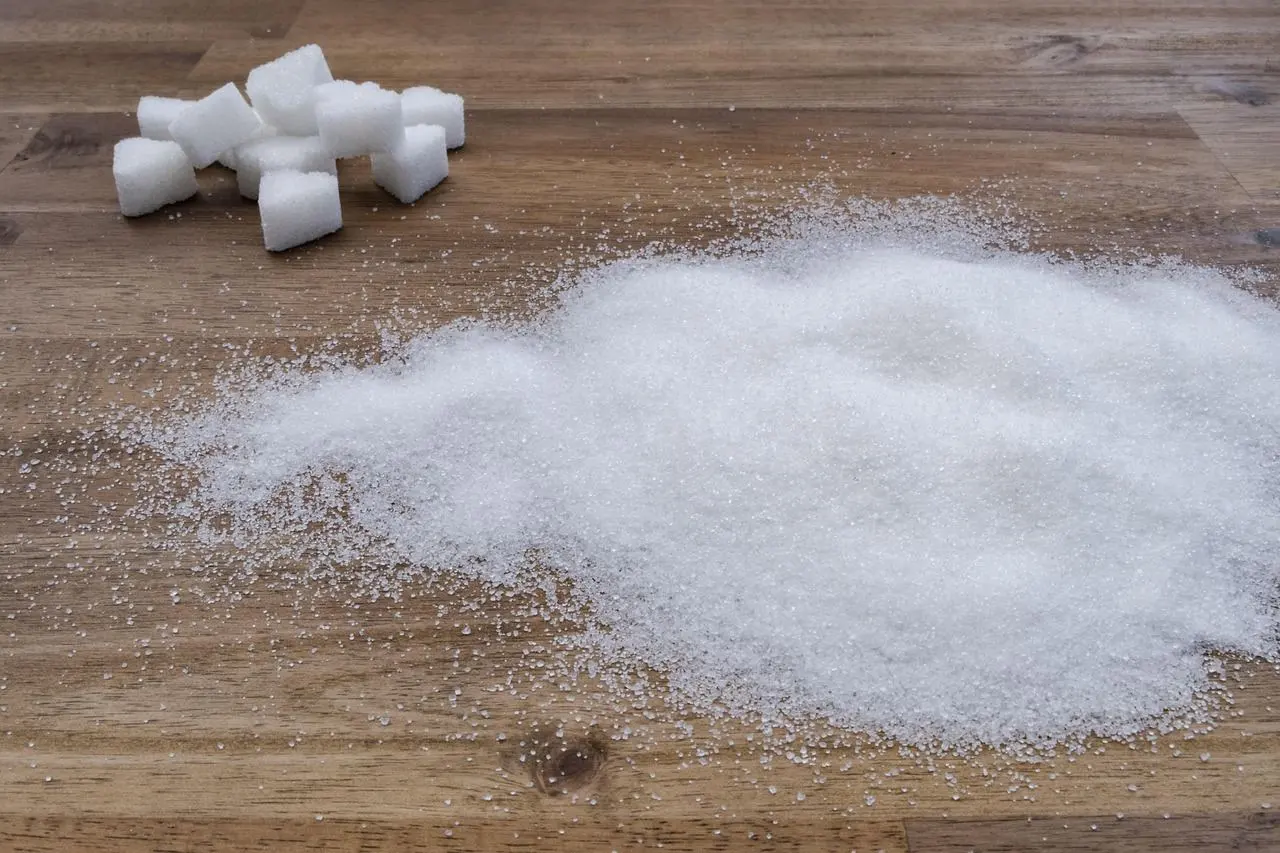
Reading the ingredients list and the Nutrition Facts label together
To learn which sugars were added, the guide says to check the ingredients list. Ingredients are listed in order by weight with the first ingredients being the largest, so a sweetener near the front is a bigger share of the product (USU Extension).
The nutrition panel splits the numbers in two. Total sugars include sugars found naturally in the food as well as any added during processing, while the added sugars line counts only the latter. There is no % Daily Value for total sugars (USU Extension).
The guide’s worked example is a product with 10 g of added sugar and 2 g of natural sugar in one portion, which shows why the two lines are read side by side (USU Extension).
The FDA’s Nutrition Facts final rule became effective on July 26, 2016, and it revised the format and appearance of the label. Its compliance date was July 26, 2018 for manufacturers with $10 million or more in annual food sales and July 26, 2019 for those with less than $10 million (Federal Register).
Honey, maple syrup and cranberry juice have special labelling rules. Those products are marked with a “†” symbol next to “added sugars” on the nutrition label (USU Extension).
A separate guide explains how to read snack food labels panel by panel. If the flavour wording on a pack puzzles you as much as the sugar names, there is also an explainer on what does natural flavouring mean.
Practical ways to shift toward lower-added-sugar snacks
The Utah State University guide frames the change as shifting rather than restricting. Its steps are small and repeatable (USU Extension):
- Move gradually toward less added sugar so your taste buds can adjust.
- Choose one or two items each week and replace them with a low-sugar option.
- Scan the labels of processed foods for phrases like “sugar free” or “no sugar added”.
- Check the nutrition facts panel for items with less added sugar.
The guide also observes that high-sugar foods are typically high in calories but low in other important nutrients (USU Extension).
Frequently asked questions
Does a sweetener that sounds natural still count as added sugar?
Show answer
In several cases it does. The guide’s list of names covers molasses, raw sugar and agave nectar alongside refined products, so judge the ingredient wording rather than the marketing around it.
Does the order of ingredients tell me how much sugar a snack has?
Show answer
It shows only relative weight, with the heaviest ingredient first. For an actual amount, read the added sugars line on the nutrition panel.
Are sugars from fruit and milk treated as added sugar?
Show answer
Not under the definition used in the guide, which leaves out sugars that occur naturally in those foods. They still show up inside the total sugars figure on the label.