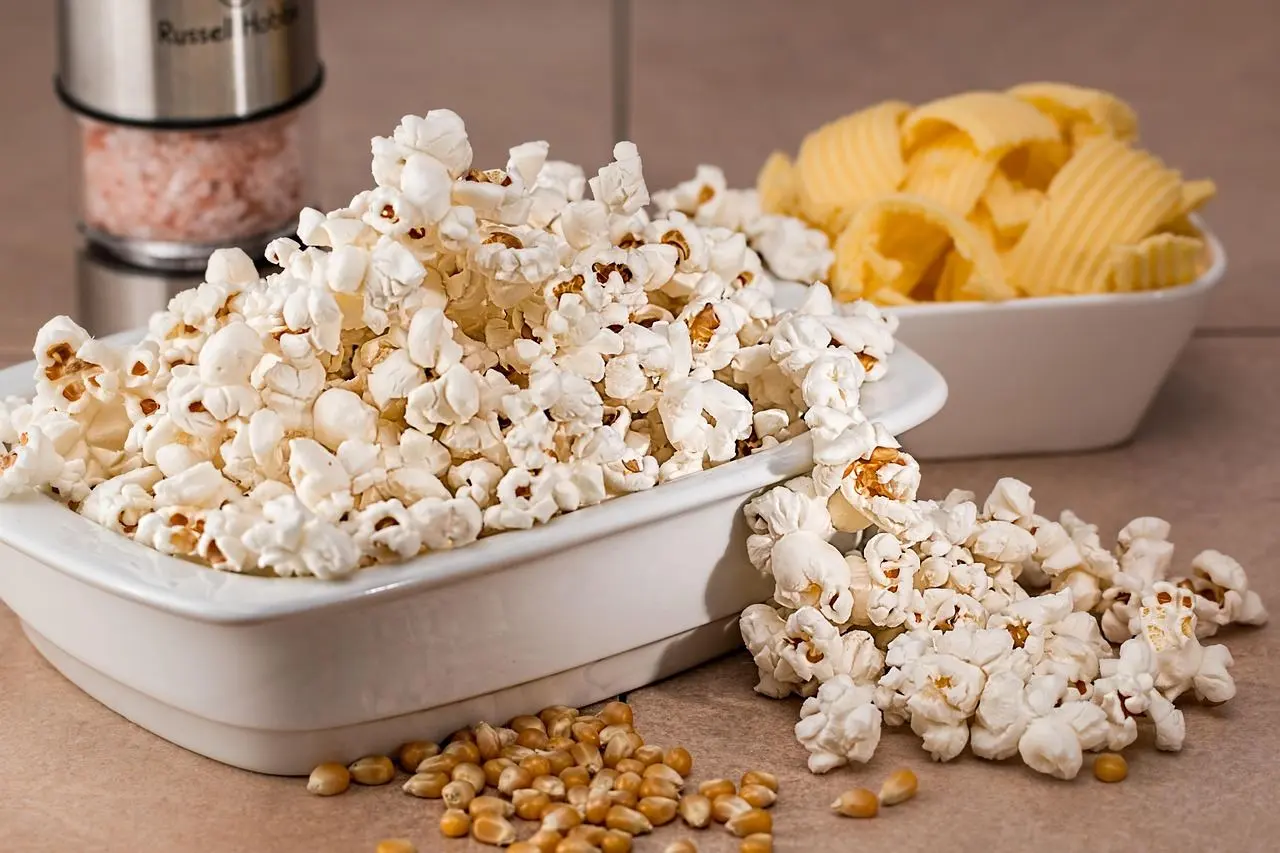
Wondering what popcorn nutrition facts look like before you fill the bowl? Plain air-popped popcorn has about 30 calories per cup, and butter or oil raises that. Here is what a serving holds.
This page is one of several guides on healthy snacks, so it sticks to the numbers.
| Item | Value |
|---|---|
| Air-popped popcorn, plain | 30 calories per cup |
| Oil-popped popcorn | 35 calories per cup |
| Lightly buttered popcorn | about 80 calories per cup |
| Fiber in a one-cup serving, air-popped and unbuttered | 1.15 g |
| Glycemic index of popcorn | 55 |
| Popcorn that equals one grain-group serving | 3 cups |
The figures come from the Popcorn Board’s nutrition page. Food data can change and brands differ, so check the source before you rely on them.
Popcorn nutrition facts for one cup
The Popcorn Board lists what a one-cup serving of air-popped, unbuttered popcorn contributes to your diet, and the numbers stay small because the kernels are so airy. Its list reads as follows:
- Energy: 30.8 kcal
- Protein: 1.03 g
- Total fat: 0.362 g
- Carbohydrate: 6.2 g
- Dietary fiber: 1.15 g
- Sugars: 0.07 g
- Cholesterol: 0 mg
The University Hospitals nutrition library gives a near-identical entry for 1 cup of air-popped popcorn, with 30.96 kcal and 1.16 g of fiber. The two entries differ slightly, so treat any single figure as a close estimate rather than an exact value.
How the cooking method changes the calories
The way popcorn is made moves the numbers more than the corn does. The Popcorn Board puts air-popped popcorn at 30 calories per cup and oil-popped at 35 calories per cup, while lightly buttered popcorn is about 80 calories per cup, as its nutrition page explains.
Nutrition Advance reaches the same direction. Its popcorn guide says oil-popping will increase the calorie and fat content of the popcorn. By weight, it adds, oil-popping also slightly decreases the carbohydrate, fiber, protein, and vitamin and mineral content.
Ready-made bags add another variable. The same guide notes that many packaged popcorn products contain large amounts of added sugar, salt, and oils, so the label on the bag is the figure to use for those.
What counts as a serving
A full bowl is rarely a single serving. The Popcorn Board says 3 cups of popcorn equal one serving from the grain group, and it puts a serving of five popped cups at 100 to 150 calories, according to its nutrition page.

Weight-based figures look quite different from cup-based ones, because popcorn is so light. Two sources show the same food measured two ways:
- 1 oz of air-popped popcorn holds 109.71 kcal, 4.11 g of fiber, 3.67 g of protein, 1.29 g of fat and 22.05 g of carbohydrate, per the University Hospitals entry.
- 100 grams of air-popped popcorn holds 385 kcal, 14.4 grams of fiber and 12.9 grams of protein, per Nutrition Advance, which draws on USDA FoodData Central.
Nutrition Advance points out that popcorn is so light that it is easy to eat a large volume for very few calories. That is why a cup, an ounce and 100 grams give such different totals.
Fiber, whole grain and glycemic index
Popcorn is a whole grain, and the Popcorn Board describes it as 100 percent unprocessed. It says one serving can provide about 70 percent of an individual’s recommended daily intake of whole grain, as its nutrition page states.
The board also names zinc, magnesium, B vitamins and fiber as nutrients that whole grains supply, and it gives popcorn a glycemic index of 55. The separate guide that asks is popcorn a whole grain goes through the whole-grain question in more detail.
Popcorn compared with potato chips
Nutrition Advance describes a 2012 human trial that compared the two snacks. In thirty-five healthy adults, six cups of popcorn (100 calories) led to greater satiety and lower energy intake at the next meal than one cup of potato chips (150 calories), as reported in its popcorn guide.
This is a single small trial, so it shows a pattern and not a rule. Readers choosing something to keep at a desk can find more options in healthy snack ideas for work.
Frequently asked questions
Is popcorn gluten-free?
Show answer
Nutrition Advance lists popcorn next to buckwheat, fonio and rice as a gluten-free grain, because all varieties of corn are, according to its guide. Flavored or packaged products can include other ingredients, so the label is still worth a look.
Which vitamins and minerals does popcorn contain?
Show answer
The Popcorn Board names folate, niacin, riboflavin, thiamin, pantothenic acid and vitamins B6, A, E and K. It adds that a serving contributes about 8 percent of the daily value of iron, with smaller amounts of calcium, copper, magnesium, manganese, phosphorus, potassium and zinc, per its nutrition page.
Why do cup and ounce figures differ between sources?
Show answer
A cup measures volume of airy kernels, while an ounce or 100 grams measures weight, so the totals cannot be compared directly. Even two cup-based entries, such as those from the Popcorn Board and University Hospitals, differ a little in their decimals.
Is store-bought popcorn as nutritious as homemade?
Show answer
Nutrition Advance considers regular air-popped popcorn the most nutrient-rich form, as its guide says. For ready-made bags, compare the printed label with the plain air-popped figures above.