Wondering why some popcorn pops fluffy while other kernels stay hard? Popcorn pops when water trapped inside each kernel turns to steam and bursts the hull, so moisture, heat and storage decide your result.
| Item | Value |
|---|---|
| Water a kernel needs to pop well | Between 14.5 and 15 percent of a kernel’s weight |
| Steam pressure the hull holds | 9.2 atm (135 psi) |
| Size of a popped kernel | 40 to 50 times its original size |
| Unpopped kernels in the worst varieties tested | As many as 47 percent |
| Unpopped kernels in the best varieties tested | 4 percent |
| US popcorn consumption | 56 quarts per person |
These figures come from Science News Explores and Carolina Biological. Figures can change or differ between sources, so check the source before you rely on them.
What is popcorn and why does it pop?
Carolina Biological’s science page says Americans consume as much as 18 billion quarts of popcorn each year, or 56 quarts per person. That makes the kernel’s chemistry worth a closer look. The page is the source for the kernel details below.
A kernel has three parts: the pericarp, the germ and the endosperm. The pericarp is the tough outer shell and the key to what makes the kernel pop, while the endosperm next to the germ holds some trapped water plus soft and hard starch granules (Carolina Biological).
When the kernel is heated, the trapped water turns into steam and pressure builds inside the pericarp. The hull ruptures at about 9.2 atm (135 psi), the steam and gelatinous starch escape, and the starch solidifies as it cools. The popped kernel ends up 40 to 50 times its original size, according to the same page.
Science News Explores compares each kernel to a pressure cooker waiting to blow. As it describes, a kernel heats up in a microwave, pot or air popper, and the water inside turns to gas and expands (Science News Explores). Carolina Biological adds that popcorn is the only grain in the corn family that pops open above 180° C.
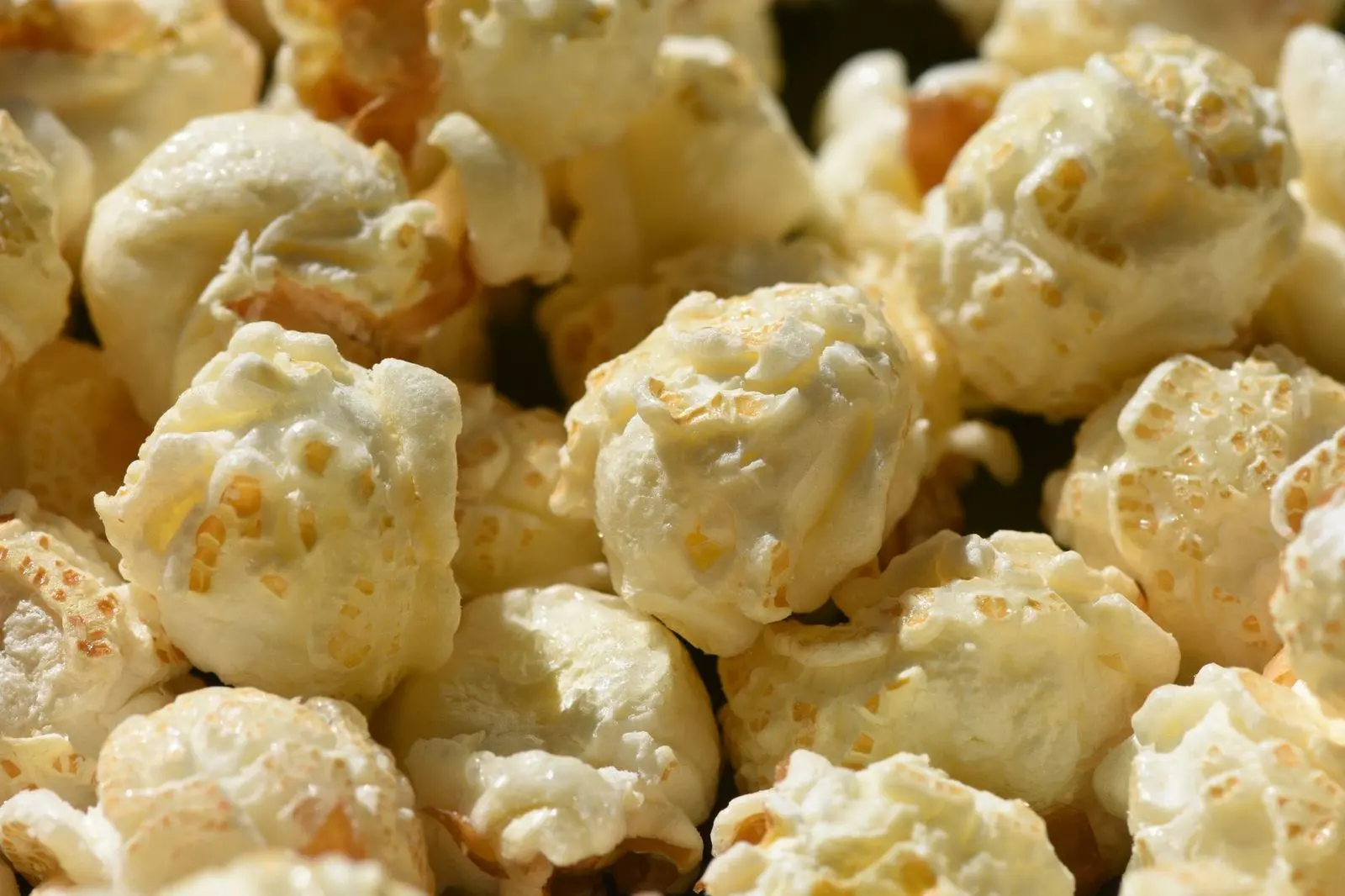
Butterfly and mushroom popcorn: the two shapes
Depending on the variety, kernels pop into one of two shapes. Science News Explores describes them like this:
- Butterfly: the most common type, big and fluffy, and it looks as if it has wings.
- Mushroom: round and compact, and better at holding cheese, caramel and other coatings without falling apart.
A separate guide to the types of popcorn kernels covers the varieties in more detail. The comparison of butterfly vs mushroom popcorn sets the two shapes side by side.
Shape matters mostly for what you plan to do afterwards. Fluffy wings suit plain or lightly seasoned bowls, while a sturdier ball suits heavy coatings.
Moisture: the quiet factor behind fluffy popcorn
Water inside the kernel is what makes the steam, so moisture matters more than almost anything else. Science News Explores says that for a kernel to pop properly, water must make up between 14.5 and 15 percent of its weight (source).
Carolina Biological describes the farm side. Corn is harvested when kernels hold between 16 and 20%, then dried by forced air in bins until it reaches an optimum of 14%. If moisture drops below that value, the popped kernels are smaller and fewer of them pop (Carolina Biological).
The two sources name slightly different optimum values, so treat the figure as a narrow band rather than a single exact number. A Purdue dissertation on microwaveable popcorn states that proper moisture content is an essential factor for final popping performance (Purdue).
Why the hull matters
Researchers studied 14 varieties of popcorn with different microwave popping qualities. In the worst varieties as many as 47 percent of the kernels did not pop, while the best had only a 4 percent failure rate (Science News Explores).
The difference lies in the hull. One-third of a kernel’s hull is cellulose, and when heated it rearranges into an orderly crystal, a sheet tighter than the original cellulose (Science News Explores). The Purdue work likewise reports cellulose and arabinoxylan as the major components of the pericarp (Purdue).
Popping methods: stove, microwave and air popper
Every method follows the same physics: heat the water inside the kernel until the hull gives way. What changes is the equipment, whether you use fat, and how much attention the batch needs.
- The pot-and-oil route is explained step by step in the guide on how to make popcorn on the stove.
- If you have no special bag, the guide on how to make popcorn in the microwave without a bag explains a bag-free approach.
- The hot-air machine route is covered in the guide to air popper popcorn.
Choosing a fat is its own question, and the guide to the best oil for popping popcorn looks at the choices. If a batch leaves many hard kernels at the bottom, read why are my popcorn kernels not popping for the usual causes.
Seasoning, storing and serving popcorn
Seasoning starts with the kernel. Mushroom popcorn is better at holding cheese, caramel and other coatings without falling apart, according to Science News Explores. You can find flavour combinations in popcorn seasoning ideas, and a separate guide explains how to make seasoning stick to popcorn.
Moisture is also why storage matters. The Purdue dissertation notes that moisture loss reduces final popcorn quality (Purdue), and the guide on how to store popcorn covers keeping it in good condition.
Carolina Biological reports that some nutritionists call popcorn a perfect snack food because it is a whole grain, a good source of fiber and low in fat (Carolina Biological). If you are weighing up options, the hub on healthy snacks is a good next stop. For ideas beyond a bowl of popcorn, browse the easy snack recipes hub.
Frequently asked questions
Why do some kernels stay unpopped?
Show answer
A Purdue study found that a hybrid with a high rate of moisture loss during microwaving produced a high number of unpopped kernels. A kernel that has dried out cannot build enough steam pressure to burst its hull (Purdue).
Do all corn kernels pop?
Show answer
No. Carolina Biological says popcorn is the only grain in the corn family that pops, and its pericarp is much stronger than that of all other corn kernels, which lets it hold pressurized steam until the hull finally ruptures (Carolina Biological).
Does storage affect how well popcorn pops?
Show answer
Moisture loss lowers quality, but one Purdue analysis of fourteen Indiana-grown hybrids found that a hybrid’s ability to hold moisture in storage had no impact on poppability. What did matter was how well kernels retained moisture while being microwaved (Purdue).
Can I coat kernels with fat to help them pop?
Show answer
Researchers found that coating kernels with certain types of fat could practically eliminate unpopped kernels. The drawback is that extra fat could make popcorn greasy, and processors would rather not add a step (Science News Explores).